Yes, you should turn your AC up when you’re not home, but leave it running. Go a few degrees warmer when you head out for the day. For a vacation of a week or more, set it about 8 degrees above your normal temperature. A warmer house pulls in heat from outside more slowly, so your air conditioner runs less while you’re gone.
Switching the system off in an Arizona summer causes a different problem. Heat soaks into your walls, floors, and furniture all afternoon, so the house takes hours to cool once you’re back, often right when electricity costs the most.
The hard part is remembering to do it every day, and that’s where we come in. Accurate Air is a family-owned heating and cooling company in Tempe, serving the East Valley since 1965. Our technicians set up thermostat schedules and tune the systems behind them. They’re salaried, not paid on commission, so you get advice about your settings, not a sales pitch.
Does Turning Your AC Up When You Leave Save Energy?
Turning your AC up when you leave saves energy because heat moves into a house more slowly when the air inside is warmer. The smaller the gap between the heat outside and the air inside, the less heat creeps in through your walls, windows, and attic. Less heat coming in means less for your AC to remove.
The U.S. Department of Energy has long backed this up. Its Energy Saver guidance recommended raising the setting about 7 degrees when no one is home. Many people worry the system has to work harder to cool the house back down, and the DOE calls that a misconception. The hours your AC rests save more than the extra run time it needs when you get back.
Your electric company agrees. SRP suggests 78 to 80 degrees when you’re home and up to 85 when you’re out. APS says you can go as high as 85 if you’ll be gone longer than a day. A warmer setting is one of the simplest ways to lower your cooling costs in summer, and it costs nothing to try.
Why Shouldn’t You Turn the AC Off Completely in Arizona?
Turning the AC off completely lets your home climb toward the outdoor temperature, and in the Valley that happens fast. The National Weather Service says Phoenix Sky Harbor averages 111 days a year at 100 degrees or hotter. Even July nights only cool to 84.5 degrees on average, so a closed-up house gets very little relief.
That heat doesn’t stay in the air. Drywall, tile, cabinets, and mattresses all warm up through the afternoon. When you switch the system back on, it has to cool all of that before the rooms feel comfortable. That can mean hours of nonstop running in the late afternoon and evening, the same hours time-of-use plans charge the most for electricity.
Monsoon season adds one more reason to leave it on. Humid storms roll through the Valley from June 15 to September 30, and the AC pulls moisture out of the air as it cools. Leaving it on, even at 85, keeps damp air from sitting in an empty house.
How Many Degrees Should You Raise the AC When You’re Not Home?
How many degrees you raise the AC depends on how long the trip is and who’s staying behind. Use this as a starting point:
| How long you’re out | Where to set the thermostat |
|---|---|
| Running errands for an hour or two | Leave it where it is. |
| At work or out for the day | A few degrees warmer than normal. |
| Away for a weekend | Warmer still, up to about 85°F. |
| On vacation for a week or more | Roughly 8 degrees above normal. |
| Pets home alone | At or close to your everyday temperature. |
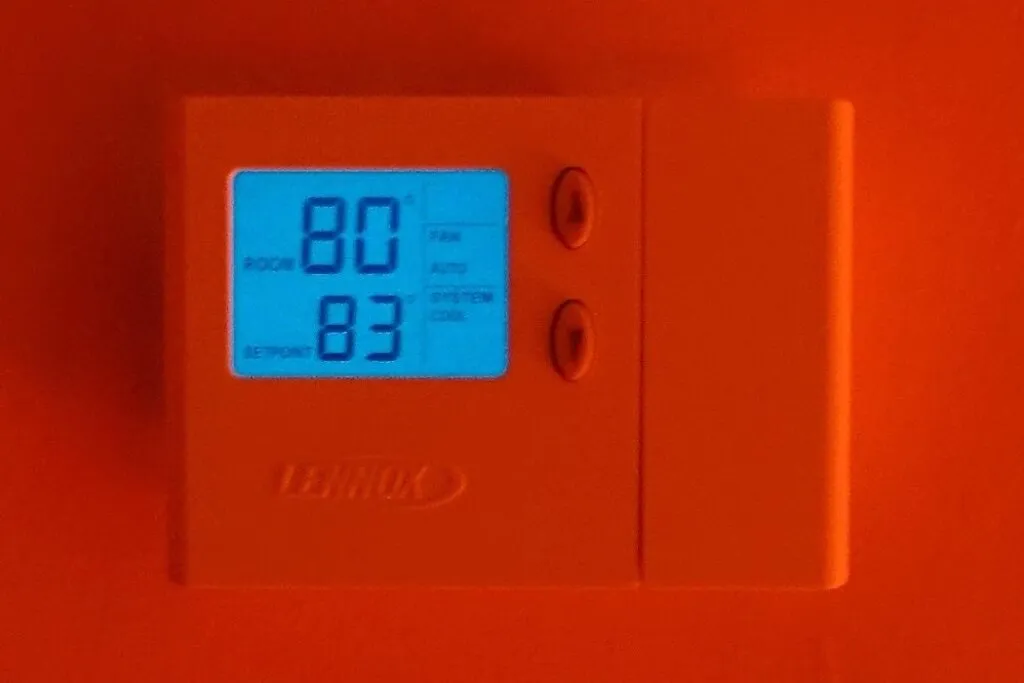
For long trips, Tom Wood, our general manager, recommends setting the thermostat about 8 degrees higher than normal instead of turning it off. If you usually keep the house at 78, that puts it at 86. The higher setting also keeps your furniture, houseplants, and candles from baking for days with no one there.
How High Can You Set the AC With Pets or Medicine in the House?
With pets or medicine in the house, keep the thermostat at or close to your daily setting instead of going the full 8 degrees. Both need a cooler home than an empty one does.
- Your dog or cat can’t open a window. The ASPCA advises keeping pets indoors in extreme heat. It says air-conditioned rooms matter most for flat-faced breeds, older pets, and pets with heart or lung problems.
- Your pills may have a temperature limit. Many prescription labels ask for storage between 68 and 77 degrees. Check yours, or ask your pharmacist, before leaving medicine in a warm house for a week.
If a pet sitter is coming by, leave the thermostat where they’ll be comfortable too. A house that feels fine to you at 9 a.m. can feel very different by 5 p.m. in July.
When Should You Cool the House Back Down Before You Get Home?
Cool the house back down shortly before you get home, and set it to your usual comfort setting, not lower. Dropping the thermostat to 70 won’t make the AC cool any faster. The Department of Energy points out that a colder setting only makes it run longer and overcool the rooms.
On a time-of-use plan, the timing matters even more, because electricity costs more during on-peak hours. SRP and APS each recommend pre-cooling. Bring the temperature down a little more before on-peak hours start, then let it drift warmer while rates are high.
| Electric plan | On-peak hours | The utility’s pre-cooling tip |
|---|---|---|
| SRP Conserve 6-9 p.m. and Save | 6 to 9 p.m. weekdays, year-round | From 3 to 6 p.m., set the thermostat 3 degrees cooler than usual, then 2 to 3 degrees warmer from 6 to 9 p.m. |
| APS Time-of-Use 4pm-7pm Weekdays | 4 to 7 p.m. weekdays | Set it lower than usual for several hours beforehand, then raise it several degrees from 4 to 7 p.m. |
Your bill shows which plan you’re on. Pre-cooling works for the same reason your AC works better at night than during the day. The cooler it is outside, the less effort it takes to keep the inside comfortable.
Can a Programmable or Smart Thermostat Turn the AC Up for You?
A programmable or smart thermostat can turn the AC up for you, so the setback happens every day whether you remember or not. A programmable thermostat runs on a schedule you set once. It goes warmer after you leave for work, back to normal before you walk in, and cooler ahead of your utility’s on-peak hours.
A smart thermostat goes a step further. ENERGY STAR notes that certified models switch to energy-saving temperatures on their own when you’re asleep or away. Many use geofencing, which reads your phone’s location to tell when you’ve left.
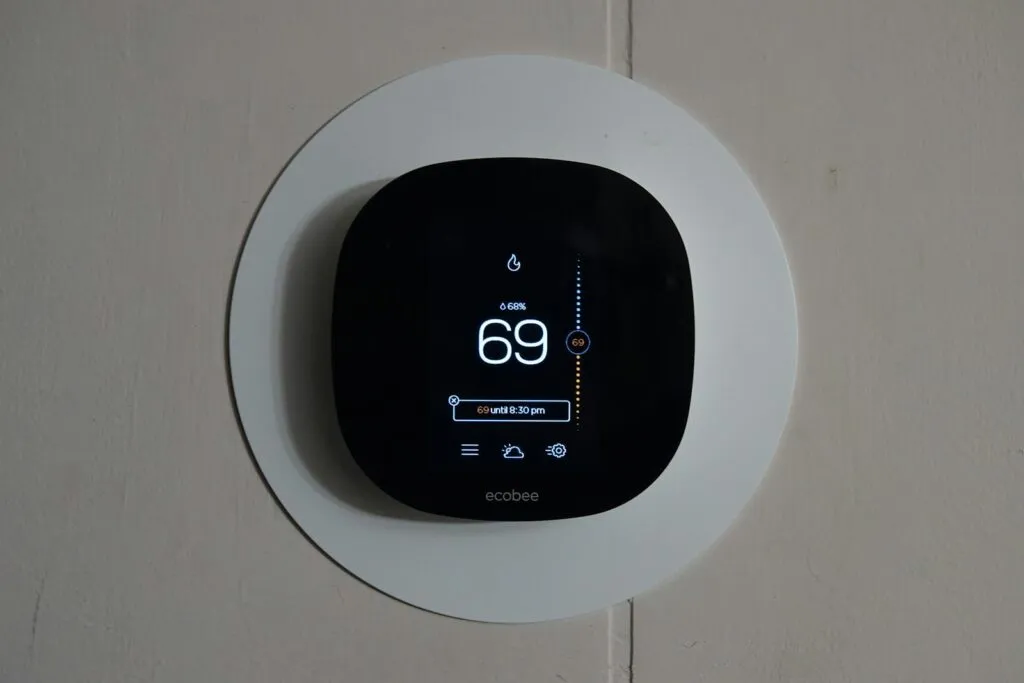
Remote control from an app is one more reason a smart thermostat is good for your HVAC system, and it’s handy on a trip. You can check the indoor temperature from anywhere and start bringing it down on the drive home from the airport.
Not sure your old thermostat can hold a schedule? Our technicians install and set up new ones in homes across Tempe and the rest of the East Valley.
What Else Helps Your AC Hold a Higher Setting While You’re Away?
Your AC holds a higher setting without straining when it’s in good shape. That means a clean filter, a clear drain line, and a recent tune-up. Before a long summer trip, take a few minutes for these:
- Change the air filter. A clogged filter slows airflow, so the system runs longer at any setting. In dusty Valley homes, HVAC filters often need changing sooner than the package suggests.
- Close the blinds on sunny windows. West- and south-facing glass lets in the most afternoon sun. Every bit of heat you block is heat your AC doesn’t have to remove.
- Look over the condensate drain line. A clogged AC condensate drain line can back up and leak water with no one there to notice.
- Leave a key with a neighbor. Someone nearby can check on the house, and any pets, if the AC stops running.
- Get the system tuned before summer. AC maintenance catches worn parts before a long run in July finds them. Members of the Accurate Advantage Club get two tune-ups a year, one before summer and one before winter, plus priority scheduling.
If your AC already struggles to keep up when you’re home, turning it up for a trip won’t fix that. Schedule an AC repair before you leave, so you aren’t coming home to a broken system.
Frequently Asked Questions About Turning Your AC Up When You’re Away
Is it bad for your AC to turn it up and down every day?
Turning your AC up and down every day is not bad for the system. A daily setback is what programmable thermostats are built to do. Dirty filters, clogged coils, and skipped tune-ups put far more strain on an air conditioner than a schedule does.
Does the same setback advice work for a heat pump in winter?
The setback advice works differently for a heat pump in winter. A large setback can make the heat pump switch to backup electric heat, which costs more. The Department of Energy advises against any setback that brings on the backup heat, and suggests a thermostat designed for heat pumps.
What should you do if your AC stops working while you’re away?
If your AC stops working while you’re away, ask a neighbor to check the thermostat and the breaker first. Move pets somewhere cool, then call Accurate Air at (602) 755-1528 to book a repair.
Who Can Set Up a Thermostat Schedule for Your East Valley Home?
Accurate Air’s technicians can set up a thermostat schedule for your East Valley home. If your thermostat can’t hold one, we can install one that does. Call (602) 755-1528 or book a visit, and we’ll have your setback running before your next trip.