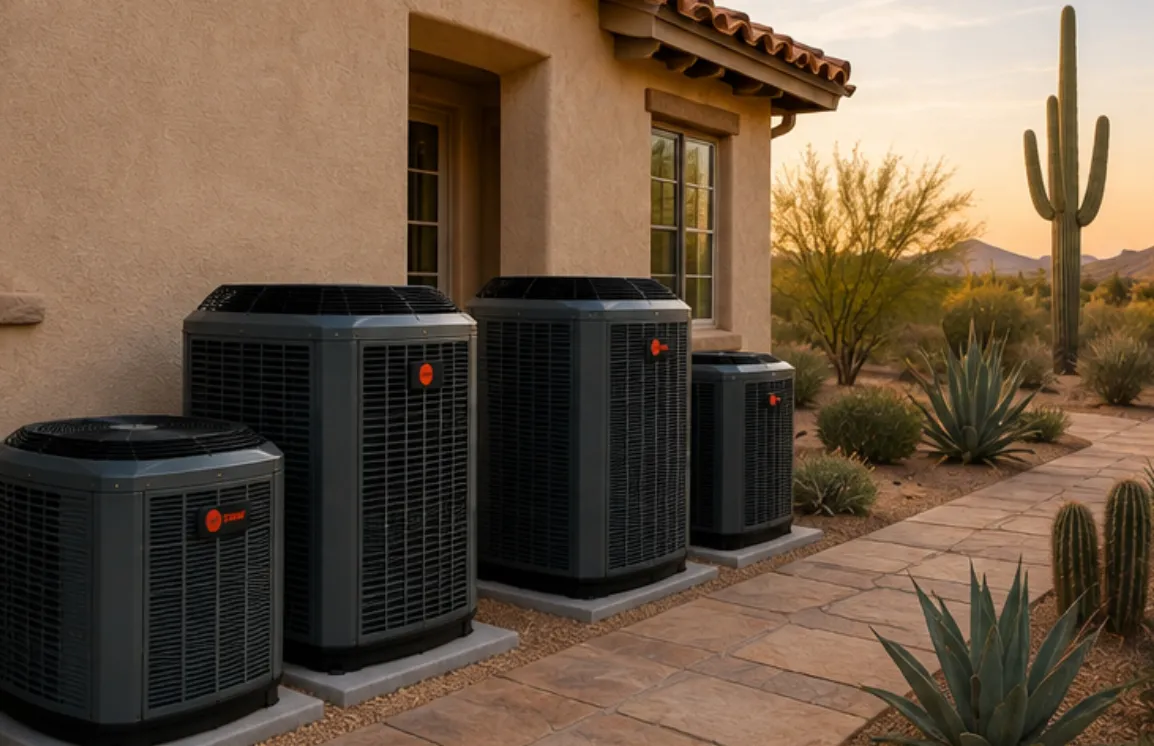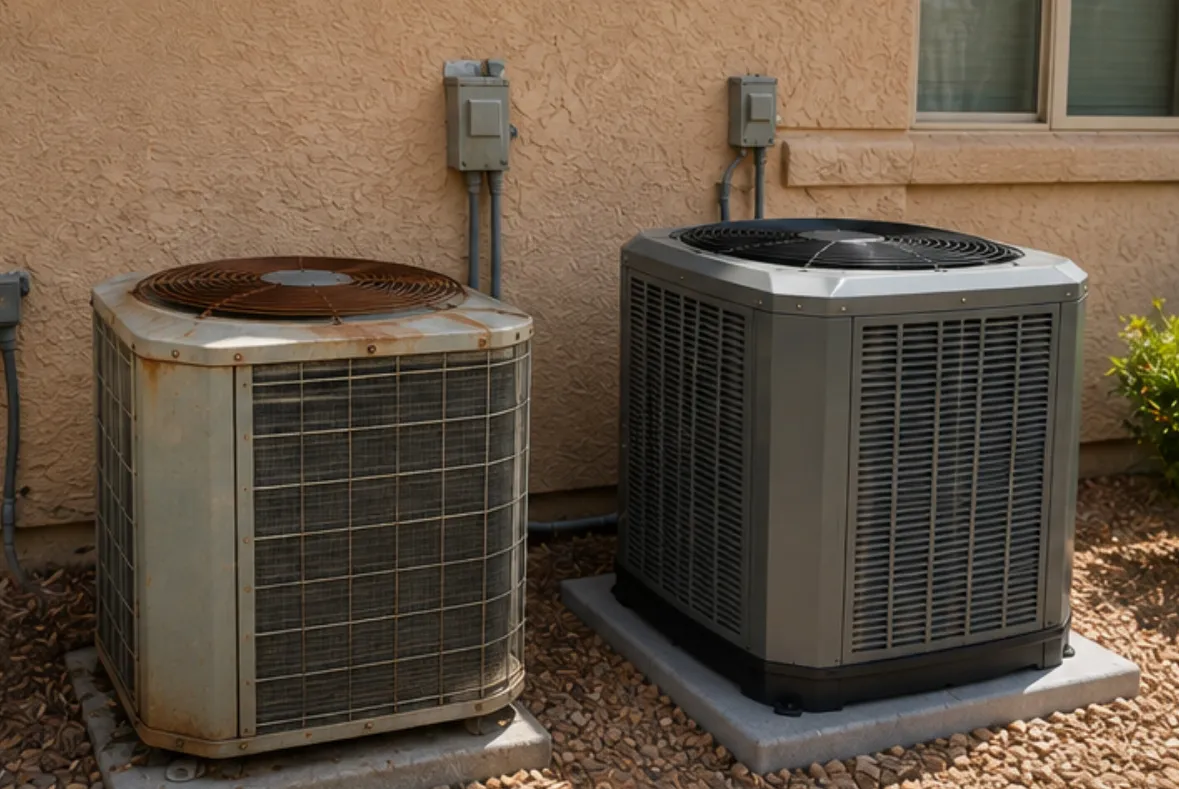
If your Tempe home is around 20 years old, there is a strong chance the air conditioner is too, and in Arizona that is well past its prime. Twenty summers of 110-degree afternoons wear equipment down quickly, and a system from the mid 2000s was built for standards and for a refrigerant that no longer applies to new installations today.
Replacing an air conditioner in an established home is a different job from installing one in a brand new build. The ductwork, the load calculation, the refrigerant, and the electrical are all inherited rather than designed from scratch, and how your air conditioning installation contractor handles those inherited details decides whether the new system outperforms the old one.
This guide explains exactly what changes when you replace the AC in a 20-year-old Tempe home, the questions that protect a $7,000 to $18,000 investment, and what a professional replacement day looks like. By the end, you will know what a thorough proposal should include and which corners you never want a contractor to cut.
Why 20 Years Counts as “Old” for a Tempe Air Conditioner

Nationally, air conditioners last 15 to 20 years, but in the Phoenix metro, you should plan on 10 to 15 years even with good AC maintenance. Our systems simply work far harder, since an AC in Tempe can run 2,000 or more hours a year, often for six months straight, while the same unit in a mild northern climate runs only a small fraction of that annual total.
At 20 years, you are not just losing efficiency. You are running a system that is overdue for a failure at the worst possible time, usually a 115-degree week in July when every HVAC company in the valley is fully booked. Recognizing the warning signs early lets you replace it on your own schedule instead of during a stressful, expensive emergency AC breakdown.
5 Signs Your Old Tempe AC Is Living on Borrowed Time
- Rising summer bills: the same or worse comfort costs more electricity each year.
- Frequent, pricier repairs: parts for older units grow scarce and expensive.
- Uneven cooling: some rooms never quite catch up on hot afternoons, the kind of imbalance a zoning system can help fix.
- Humid, sticky air: the system can no longer manage moisture during monsoon season.
- Constant running: the unit rarely shuts off and has grown noticeably louder.
If several of these sound familiar, another AC repair is usually just throwing money at a system already on its way out. Planning a replacement now, before the next heat wave hits, gives you room to compare proposals carefully and choose the right Trane system instead of whatever a contractor can install fastest.
Get a written AC replacement quote
How Replacing an AC in an Existing Home Isn’t the Same as a New Build
In new construction, the equipment, ductwork, and electrical are all engineered together from the very first blueprint. In a 20-year-old home, your contractor is working with whatever already exists in the attic and on the pad, and that is exactly where quality separates from cost-cutting. A proper replacement corrects what was wrong two decades ago instead of quietly repeating it.
Skipping that correction is how homeowners end up with a shiny new system that still cannot cool the back bedroom. The best contractors treat a replacement as a chance to fix the sizing, airflow, and duct problems that the old unit simply masked for years. The sections below cover each thing that should change when your new system goes in.
What Should Change When Replacing a 20-Year-Old AC?

Replacing a 20-year-old air conditioner in Tempe should not mean disconnecting the old equipment and putting a newer model in the same place.
The original system was selected under different efficiency standards, refrigerant requirements, and often very different assumptions about the home’s insulation and airflow. A quality replacement examines the parts of the existing system that could limit the performance of the new Trane equipment.
Resize the System With a Manual J Load Calculation
The old unit’s tonnage should not determine the new unit’s size. An ACCA Manual J load calculation considers the home’s windows, insulation, orientation, square footage, and heat gain to determine the cooling requirement your home has today.
If the home has received new windows, insulation, doors, or other improvements during the past 20 years, the correct replacement may be smaller than the original system.
Inspect and Correct the Attic Ductwork
A 20-year-old duct system has spent two decades exposed to extreme attic temperatures. Loose connections, deteriorated insulation, crushed flexible ducts, and undersized returns can restrict airflow long before the equipment itself fails.
A contractor should measure static pressure and inspect the accessible ductwork before deciding whether the existing ducts can support the new system.
Handle the R-22 Refrigerant Switch
An older Tempe system may use R-22, while current replacement equipment uses newer refrigerant technologies. R-22 production and import ended in the United States in 2020, making repairs and refrigerant replacement increasingly expensive.
A new system cannot simply be connected to an old refrigerant circuit without following the manufacturer’s requirements for the new equipment.
Jump From 8 SEER to as High as 22 SEER2
A 20-year-old air conditioner may have originally carried a rating around 8 to 10 SEER, while today’s equipment can provide substantially higher efficiency.
Trane’s current residential lineup includes systems reaching approximately 22 SEER2, depending on the model and matched system configuration. That difference matters in Tempe, where cooling can account for a substantial portion of summer electricity use. If you want efficient heating from the same system, it is worth pricing a heat pump replacement against a straight AC before you decide.
Commission the System, Not Just Switch It On
The installation isn’t finished when cool air comes from the vents. A professional crew should verify airflow, static pressure, refrigerant charge, temperature split, superheat, and subcooling during startup. These measurements provide evidence that the new Trane system is operating correctly rather than relying on the thermostat alone.
The goal is not simply to replace a 20-year-old outdoor unit. It is to correct the limitations that accumulated around the old system so the replacement delivers the efficiency, airflow, and comfort you expect from modern equipment.
How Should You Compare AC Replacement Proposals in Tempe?
Three contractors can quote the same Trane system and produce three very different installation scopes. One proposal may include duct corrections, electrical updates, startup commissioning, and warranty registration, while another may price only the equipment and basic labor. That makes the final dollar amount almost meaningless until you know exactly what each contractor is including.
Use the proposal itself as your comparison tool. A detailed estimate should identify the equipment being installed and explain what happens to the existing components.
| Proposal Detail | What to Look For |
|---|---|
| System sizing | Manual J calculation rather than simply matching the old tonnage |
| Equipment | Complete Trane model numbers and AHRI-matched components |
| Ductwork | Inspection and repairs where airflow or leakage is a concern |
| Refrigerant system | Clear explanation of line-set compatibility and refrigerant requirements |
| Electrical work | Verification that disconnects, breakers, wiring, and equipment requirements are appropriate |
| Commissioning | Documented airflow, static pressure, refrigerant, and temperature measurements |
| Warranty | Manufacturer parts coverage plus clearly stated labor protection |
| Permits | Responsibility for required Tempe installation permits |
| Financing | Available payment options if the replacement is being financed |
Pay particular attention to proposals that simply say “replace existing 4-ton AC” without explaining why four tons is still appropriate. The existing system may have been oversized from the beginning, or improvements made to the house over the last 20 years may have reduced its cooling load.
The best proposal isn’t necessarily the longest or most expensive. It is the one that demonstrates the contractor has evaluated the existing home’s limitations and has a specific plan for addressing them.
What Happens During a Professional AC Replacement in Tempe?

A straightforward replacement can often be completed in one day, but the schedule depends on the condition of the existing ductwork, electrical connections, refrigerant lines, and indoor equipment. A professional crew should explain the scope before work begins rather than springing major installation requirements on you after the old system has already been removed.
The Home Is Protected First
The crew should protect flooring and interior surfaces before bringing equipment through the home. The installation area is prepared so the old indoor unit can be removed without unnecessary damage to the surrounding space.
The Existing System Is Safely Removed
The old equipment is disconnected and refrigerant is recovered using approved procedures. If the system contains R-22, it should never be intentionally vented. The contractor should also inspect the existing connections and components before deciding what can safely remain.
Existing Problems Are Corrected
This is where replacement quality can differ significantly. The crew may need to correct duct connections, modify the plenum, replace deteriorated insulation, update electrical components, or address thermostat and refrigerant-line requirements before installing the new equipment.
The Trane System Is Installed
The new indoor and outdoor equipment is installed as an AHRI-matched system, with the refrigerant circuit properly prepared according to the manufacturer’s specifications. The equipment is then connected to the home’s electrical, ductwork, drainage, and control systems.
The System Is Commissioned
Before the crew leaves, the system should be started and measured rather than simply switched on. Technicians verify airflow, static pressure, refrigerant conditions, temperature split, and other operating readings to confirm the installation is performing correctly.
A replacement that follows this process gives you something more valuable than a new outdoor unit. It gives you a documented installation designed to correct the problems that may have limited the old system for years.
Why Choose Accurate Air for Your Tempe AC Replacement?

Once you’ve compared equipment and installation proposals, the most important question becomes who will perform the work. A 20-year-old Tempe system presents challenges that aren’t visible from the model number alone, particularly when the existing ductwork, refrigerant lines, electrical components, and system sizing were designed two decades ago.
With 60 years of HVAC experience, Accurate Air treats every replacement as more than simply swapping out an old unit. Our air conditioning installation service includes properly sizing the new Trane system, evaluating the existing ductwork, and carefully testing the equipment after installation, so your home gets consistent, efficient cooling.
If your aging AC is still running but struggling through Tempe’s summer heat, replacing it before a major failure gives you time to compare your options. Accurate Air also keeps your new system healthy through the Accurate Advantage Club and offers flexible financing options, including 0% APR for up to 60 months on qualifying Trane installations. Contact our team to talk through your replacement and see what a properly designed Trane system can do for your home.